


How We Started
Daniel Robertson and Ryan Kintz founded Afton in 2004 with the intent to fill a need they saw in their local music community. Their band, Faded, as well as many of the bands they were friends with, were having a difficult time booking shows at the bigger, more legit music venues in town that would provide the opportunity and all ages atmosphere they were looking for.
Kintz & Robertson built their company upon the “Golden Rule”, that is – everything that Afton asks their artists to do, and every policy and standard that Afton has created, Kintz & Robertson both did themselves. They abided by the same standards and policies with their own band, and decided to help other local artists grow by sharing their experience.
“Everything we ask our artists to do, and every policy we created, was based upon what our band members did ourselves. We ask our artists to sell tickets because our band always drew 5x to 10x more fans when we sold tickets, we follow our fairness policies because we were tired of politics and favoritism screwing over the bands that worked the hardest to draw fans to the club. We practiced what we preach, and we do for other bands what we did for our own band.” – Ryan Kintz
Afton was not created by a big record label or by a large corporation, Afton was created by two local musicians who put into practice everything Afton was founded upon. Afton has been built upon the blood, sweat, tears, and 60+ hour work weeks that Kintz & Robertson have put in.
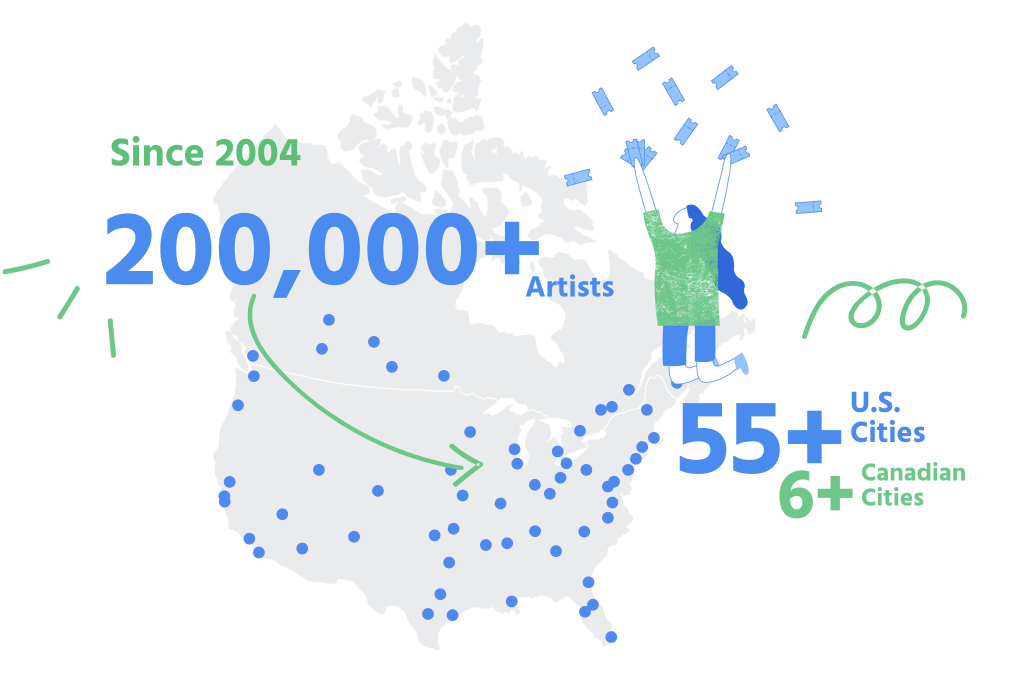
Since 2004, Afton has booked over 60,000 local acts (roughly 185,000 band/group members), on over 9,500 Afton concerts, in over 40 cities. Afton has also helped more than 200 all-ages venues not only survive, but thrive – in an industry that has traditionally made it very difficult for all ages establishments to even stay in business long term.
MORE ON EARLY AFTON…
“No one would let our band play,” explains Daniel Robertson (co-founder) of Afton, “that was pretty much it.” Thus, the reasoning behind the creation of the company was just that simple. “If the club owners were too busy to give time to local bands like us, we figured we better start putting on our own shows, doing all of the booking work, and taking on all financial risk ourselves. So that’s what we did.”
“We knew that the next step for our band was to start playing real shows, at legit music venues, where we could bring out our fans who weren’t 21+ yet.” Interjects Ryan Kintz (co-founder), “instead of just playing dive bars, barbecues, school dances, and fundraisers. But no one who was booking shows around Portland wanted to give local bands like us a chance.”
Kintz and Robertson spent four years as part of an alternative rock band called Faded. “Ryan and I had been playing in bands together since junior high, but most of them never even left the garage! It’s hard to take your band from your garage to the next level when you don’t even know how to get shows at the nicer music venues in town.” Robertson reminisces, “that is why we exist. We want local bands to have a reason to get better, to have a reason to practice every single week, to have a reason to get committed to their music, and nothing is a better motivator for that then getting live shows at the legit music venues in town.”
However, as Kintz explains, not all “gigs” are created equal. “We grew up about 50 miles away from the nearest major city, so we didn’t even know it was possible for us to play real rock shows, without being signed or on tour.” Faded spent about 18 months performing with surprising regularity at miscellaneous events around their home town: several non-profit events, a few festivals, coffee shops, a handful of graduation and birthday parties, a couple high school dances, and even a wedding – just to name a few.
Robertson recalls, “the more we played live, the more we felt like something was missing – namely, a real stage with screaming fans in front of it, at a notable venue.” So, Kintz and Robertson set out to devise a plan that would allow Faded to achieve its full potential. “We started scouring the internet for advice about the music industry, and we even spent hundreds of hours reading books about growing your career the DIY way without the help of record labels, managers, or booking agents.”
“We called every booking contact we could find, but we just kept getting the club’s main answering machines – the ones where you call in and a voice reads off their calendar listing and gives you directions to the club,” says Robertson, “We also sent emails all over the place, but we got very few responses,” he continues. “Those that did respond said they were looking for more “experienced” acts with a more “mature sound” – or something along those lines. Basically they thought our music wasn’t good enough, or the booking person just didn’t respect our style of music,” he admits with a slight twinge of sarcastic sheepishness.
Kintz elaborates, “we literally heard from one club owner that he wasn’t interested because Faded was too Emo, while another club owner down the street claimed he would not book Faded because we were not Emo enough! Understandably, this obvious paradox led both Kintz & Robertson frustrated, to say the least. “These criticisms and personal bias of venue owners did not seem constructive, and it seemed that such a subjective and judgmental outlook on booking local bands hurt the local music scene by shutting out local bands that deserved a chance to display and further hone their musical skills.” Kintz remembers the feeling, “It was so hard not to feel helpless… It was such a horrible feeling.”
After many calls, emails, and press packs over several months, Kintz finally happened to catch the owner of famed local venue, The Meow Meow, on the phone – thanks to a somewhat desperate, late-night attempt to reach someone by phone. “He told me that there were no openings on either of his two all-local shows next month,” recounts Kintz. “He said that the only shows on the calendar that were still being booked were small and mid-sized tours coming through town, and he explained the opening slots for those would go only to local bands with established draws of more than 100+ fans per show.”
After an hour-long discussion, the club owner admitted that Faded’s only chance of getting a show that month at his venue would be for Kintz to book the show himself, do all of the legwork, run the show, and to personally take on all financial risk that night! “Despite the criticism we heard from other booking people in town, we liked our music and so did most of our friends, so we figured we’d give it a shot.” Explains Robertson, “Booking the show ourselves was a ton of work – to say the least – and the constant stress of knowing we were personally responsible for all financial overhead of the show made things even crazier. We had our entire band fund sunk into that first show, and if attendance sucked we basically would have lost all of the money we had personally saved up the past 18 months as a band.”
Kintz interjects, “We didn’t really have any other option, so we promoted like crazy and we had a packed out show, it was amazing.” After that first show, Kintz & Robertson booked one show per month for almost an entire year – giving Faded consistent opportunity to put their plan into action. “After we’d done about 10 shows, the club owner explained that due to the venue moving to a bigger location, and business being slow, the club might have to close – unless we could somehow start booking 4-5 more shows per month,” says Kintz. “We offered to give it a try, because if this club closed down, it would screw over our band and all of the local bands we had become friends with – including the touring bands that would come through.” So, out of necessity, Afton was born.
Faded broke up in mid 2005 (when their drummer/producer chose to leave the band to start a family), but not before Faded became the highest drawing Afton artist of all time, still to this day.
More than 250 Faded fans came out specifically to see Faded play their CD Release show for “Take Me Anywhere,” and gave Kintz & Robertson the experience they had initially set out to create so many years before – “a real stage with a ton of fans in front of it.”
“We were sad to see Faded come to an end, but the fun we had and work ethic we learned from being in that band were priceless,” says Robertson. Afton was born out of the belief that every artist deserves the opportunity to create a similar experience for themselves.
“Even though we wholeheartedly believed our music was good, the negative things those booking people said really bummed me out,” concludes Kintz. “The difference is, now I know our music was good, because we proved that at least 250 of our closest fans thought so too.”
“Local artists deserve attention, and they deserve an outlet to play live and build their fan base. Period. That is why we exist, that is why we have worked so hard at doing the best we can for our artists, and that is why we will always be an extra option that all local artists have for shows. Every month, year round.” concludes Robertson.